In today’s fast-paced industrial landscape, the ability to make informed decisions quickly is crucial for maintaining operational efficiency and asset longevity. As facilities grow in complexity, the demand for innovative solutions that can streamline maintenance is more pressing than ever. Enter infrared thermography services, a cutting-edge technology that transforms data into actionable insights, paving the way for predictive maintenance workflows. In this article, we explore how aerial infrared thermography, particularly through companies like AIT Scan, plays a pivotal role in data-driven decision-making for predictive maintenance, using a case study approach.
The Importance of Predictive Maintenance in Asset Management
Predictive maintenance is a proactive strategy focused on forecasting potential failures before they occur, thereby minimizing downtime and optimizing asset performance. This approach is invaluable for facility managers, engineers, and decision-makers responsible for large infrastructures. By anticipating issues, businesses can avoid costly repairs, enhance safety, and extend the lifespan of critical assets.
Traditional maintenance practices often rely on reactive or scheduled maintenance, which can be inefficient and costly. In contrast, predictive maintenance leverages advanced technologies like infrared thermography to gather real-time data and anticipate equipment failures. This data-driven approach not only saves money but also supports strategic capital planning and enhances operational efficiency.
Infrared Thermography: A Game-Changer in Predictive Maintenance
Understanding Infrared Thermography
Infrared thermography is a non-invasive technology that detects thermal anomalies by capturing and analyzing infrared radiation emitted by objects. This technology is particularly useful in identifying issues that are not visible to the naked eye, such as electrical faults, mechanical defects, and insulation failures. By providing a comprehensive thermal profile, infrared thermography enables facility managers to pinpoint potential problems before they escalate.
Application in Aerial Infrared Surveys
AIT Scan specializes in aerial infrared surveys, offering a broad view of large-scale assets such as commercial roofs, solar fields, and underground utilities. The use of aircraft-based infrared scanning provides significant advantages in terms of coverage and efficiency, particularly for extensive facilities and geographically dispersed assets. For instance, aerial infrared roof scanning allows for efficient detection of moisture intrusion across vast commercial roof portfolios, essential for preventing structural damage and ensuring waterproofing integrity.
For more details on aerial infrared roof scanning, visit AIT Scan’s service page.
Case Study: Leveraging Infrared Thermography for Solar Field Maintenance
Solar energy facilities face unique challenges in maintaining optimal performance. Photovoltaic panels are susceptible to various issues like shading, soiling, and component failures, which can severely impact energy output. AIT Scan’s solar field infrared surveys are designed to identify these issues swiftly and accurately.
Real-World Application
Consider a solar farm experiencing unexplained drops in energy production. By deploying AIT Scan’s aircraft-based infrared thermography, facility managers can quickly identify hotspots indicating faulty panels or connections. This precise detection allows for targeted interventions, reducing downtime and maintaining peak performance.
For more information on solar field infrared surveys, check out AIT Scan’s dedicated page.
Detecting Underground Steam Leaks with Infrared Thermography
Underground steam systems are critical components in many industrial and campus settings. Leaks in these systems can lead to significant energy losses and pose safety risks. Infrared thermography is a powerful tool for detecting these leaks without disrupting operations.
Efficient Leak Detection
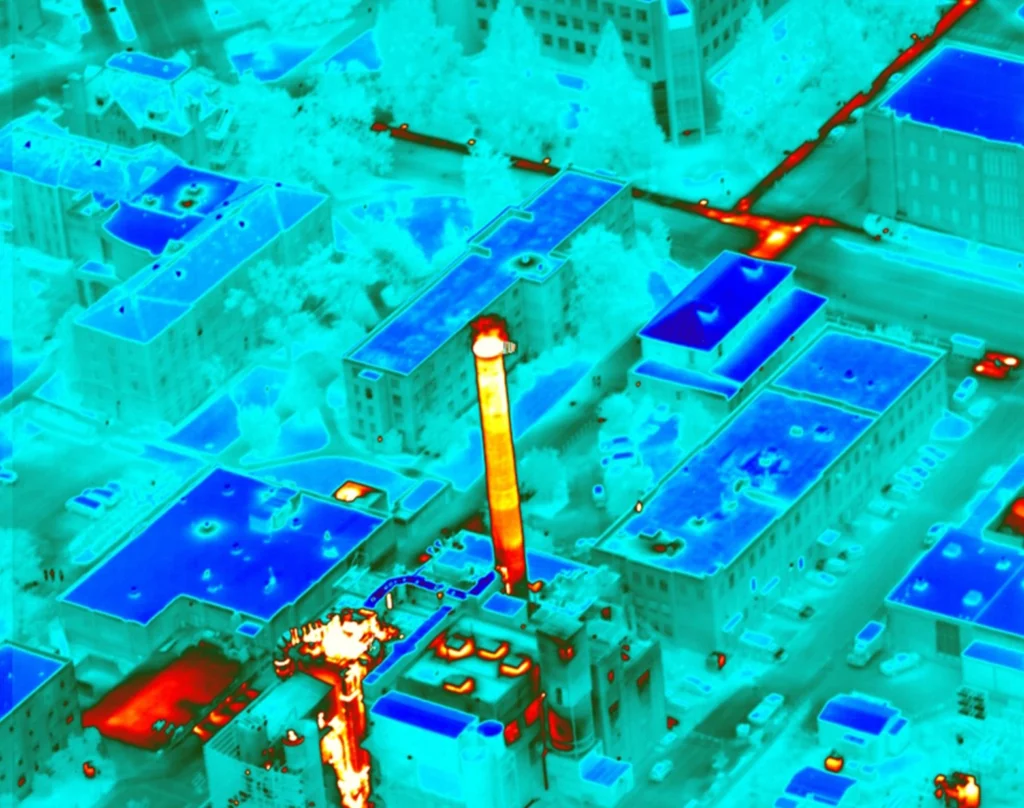
Using aerial thermal imaging, AIT Scan can detect minute temperature variations indicating steam leaks. This non-invasive method allows for the rapid assessment of entire districts or campuses, ensuring efficient steam distribution and minimizing energy wastage.
Explore more about high-temperature hot-water leak detection on AIT Scan’s service page.
Benefits of Aircraft-Based Infrared Scanning
Comprehensive Coverage
One of the standout benefits of aircraft-based infrared scanning is its ability to cover vast areas quickly and effectively, which is crucial for large facilities and campuses. This method offers a broader perspective compared to ground-based or drone inspections, making it ideal for facilities with extensive infrastructures.
Enhanced Decision-Making
By providing detailed thermal mapping, aircraft infrared scanning supports informed decision-making. Facility managers can prioritize maintenance tasks based on the severity and location of detected issues, optimizing resource allocation and minimizing disruption.
Learn more about AIT Scan’s comprehensive services, including city-wide thermal mapping, at AIT Scan’s CityScan IR page.
Conclusion
Infrared thermography is a transformative tool in the realm of predictive maintenance, offering unparalleled insights into asset conditions. By leveraging AIT Scan’s expertise in aerial infrared scanning, facility managers can make data-driven decisions that enhance operational efficiency and extend asset life. Whether it’s through detecting roof moisture, identifying solar panel faults, or locating underground steam leaks, infrared thermography services are integral to modern asset management strategies. To explore how AIT Scan can assist in optimizing your facility’s maintenance workflows, reach out for a consultation today.